Philadelphus
Philadelphus coronarius
Shrubs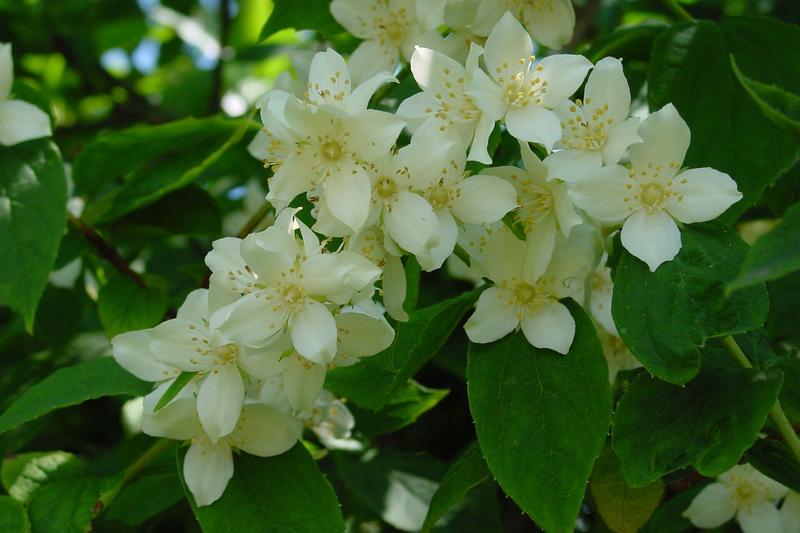
Quick facts
- Watering
- Weekly during dry spells
- Sunlight
- Full sun to partial shade
- Soil
- Moist, well-drained, fertile
- Humans
- Safe
- Cats
- Safe
- Dogs
- Safe
- Height
- 200–300 cm
- Spread
- 150–250 cm
- Spacing
- 150–200 cm apart
- RHS recognition
- Award of Garden Merit
About Philadelphus
Philadelphus is a deciduous shrub cherished by UK gardeners for its profusion of fragrant white flowers in early summer. Native to southern Europe and Asia Minor, this hardy shrub has been a cottage garden favourite since the 16th century. Its intoxicating orange-blossom scent and arching habit make it ideal for mixed borders, informal hedges, and wildlife gardens. The simple four-petalled flowers attract bees and other pollinators, whilst the dense foliage provides excellent nesting cover for garden birds.
UK fact: Philadelphus coronarius has held the RHS Award of Garden Merit since 1993 and thrives particularly well in British gardens, where the cool, moist climate encourages vigorous growth and abundant flowering without the stress common in hotter, drier regions.
Watering Philadelphus
Water newly planted shrubs weekly during their first summer, providing approximately 10 litres per plant during dry periods. Established plants generally cope well with typical UK rainfall and only require supplementary watering during prolonged dry spells in summer. Apply water at the base of the plant rather than overhead to reduce the risk of fungal diseases. In containers, water more frequently as compost dries out faster, checking soil moisture twice weekly during warm weather.
Sunlight requirements
Plant in full sun for the best flowering display, though it will perform adequately in partial shade with at least four hours of direct sunlight. In British gardens, a south or west-facing position is ideal, though east-facing spots work well in southern counties. Avoid deep shade beneath trees, as this significantly reduces flowering and can lead to leggy growth.
Soil and feeding
This adaptable shrub tolerates a wide range of soil types, from clay to sandy loam, provided drainage is adequate. It prefers a neutral to slightly alkaline pH of 6.5–7.5 but will grow in mildly acidic conditions. Improve heavy clay soils by incorporating organic matter and grit before planting to prevent winter waterlogging. On thin chalky soils, add plenty of well-rotted compost or manure to improve moisture retention and fertility.
Feed established plants each March with a general-purpose granular fertiliser such as Growmore or blood, fish and bone, scattering approximately 70g per square metre around the root zone. Follow with a 5–7cm mulch of well-rotted compost or manure, keeping it clear of the stems. Container-grown specimens benefit from a liquid feed every fortnight during the growing season using a balanced fertiliser.
Pruning Philadelphus
Philadelphus flowers on the previous year's wood, so prune as soon as flowering finishes in July or early August. Cut back flowered shoots to strong buds or young sideshoots lower down, and remove up to one-third of the oldest stems entirely at ground level to encourage fresh growth from the base. This rejuvenation pruning maintains an open framework and prevents the shrub becoming congested. Neglected specimens can be hard-pruned in late winter, though this sacrifices one season's flowers.
Propagating Philadelphus
Semi-ripe cuttings taken in midsummer root readily and are the quickest method for producing new plants. Select healthy, non-flowering sideshoots approximately 10–15cm long with a heel of older wood if possible. Hardwood cuttings taken in November and December are even simpler, requiring minimal aftercare. Layering low-growing branches in spring provides an almost foolproof method, with rooted layers ready to sever and transplant the following autumn.
Common problems
Philadelphus is generally trouble-free in UK gardens, though aphids may colonise soft new growth in spring, causing distorted shoots and sticky honeydew. Leaf spot fungi occasionally appear during wet summers, causing brown markings on foliage, but rarely warrant treatment. Poor flowering is usually due to excessive shade, incorrect pruning timing, or over-feeding with high-nitrogen fertilisers that promote leafy growth at the expense of blooms. Blackfly infestations can be controlled by encouraging natural predators or washing off with a strong jet of water.
Spot a problem with your plant? Photograph the affected area using the Loam app and it will suggest the most likely cause and treatment.
Safety
- Humans
- Safe
- Cats
- Safe
- Dogs
- Safe
Toxicity information is for general guidance only.
Seasonal care calendar
Monthly care guide for Philadelphus in the UK, based on average conditions.
| Month | Care tasks |
|---|---|
| January | No action needed. Plants are fully dormant. |
| February | Check ties and stakes on newly planted specimens after winter gales. |
| March | Apply balanced fertiliser around the root zone and mulch with well-rotted organic matter. |
| April | Watch for aphid infestations on new growth and treat if necessary. Water newly planted shrubs during dry spells. |
| May | Buds begin to swell. Continue watering young plants and remove any dead or damaged stems noticed. |
| June | Main flowering period begins. Enjoy the fragrance and deadhead spent blooms if practical to keep plants tidy. |
| July | Prune immediately after flowering finishes, removing flowered shoots and one-third of old stems. Take semi-ripe cuttings for propagation. |
| August | Continue taking semi-ripe cuttings early in the month. Water during prolonged dry periods. |
| September | Good time to plant new specimens. Prepare planting holes with plenty of organic matter. |
| October | Continue planting. Collect and compost fallen leaves. Check cuttings taken in summer. |
| November | Take hardwood cuttings and insert into a sheltered trench outdoors. Plant bare-root specimens. |
| December | No action needed. Plants entering full dormancy. |
Frequently asked questions
- When should I prune Philadelphus?
- Prune Philadelphus immediately after flowering in July, removing spent flower stems and cutting back around a quarter of the oldest stems to ground level. This timing is crucial as flower buds form on the previous year's wood—pruning in winter or spring removes the stems that would flower that summer. For overgrown plants, hard renovation pruning can be done in late February or March, though you'll sacrifice that year's flowers.
- How do I identify what's wrong with my Philadelphus?
- Common Philadelphus problems include poor flowering (usually due to incorrect pruning, shade, or high-nitrogen feeding), blackfly infestations on new growth in spring, and general lack of vigour from neglect. The Loam app can help diagnose specific issues through photos of your plant, provide personalised care reminders for pruning and feeding at the right times, and offer tailored advice based on your garden's conditions.
- How do I take cuttings from Philadelphus?
- Take semi-ripe cuttings in July or August, selecting healthy side shoots 10–15cm long. Remove the lower leaves, dip the cut end in hormone rooting powder, and insert into pots of gritty compost. Keep in a sheltered spot or cold frame—cuttings typically root within 6–8 weeks. Alternatively, take hardwood cuttings in November from pencil-thick stems, inserting them directly into a sheltered trench outdoors where they'll root by spring.
Got a question about growing Philadelphus that isn't covered here? Ask the Garden Advisor in the Loam app. It knows your saved plants and local conditions.
Related plants
This page was compiled with AI assistance and reviewed by our team. .