Indian Bean Tree
Catalpa bignonioides
Trees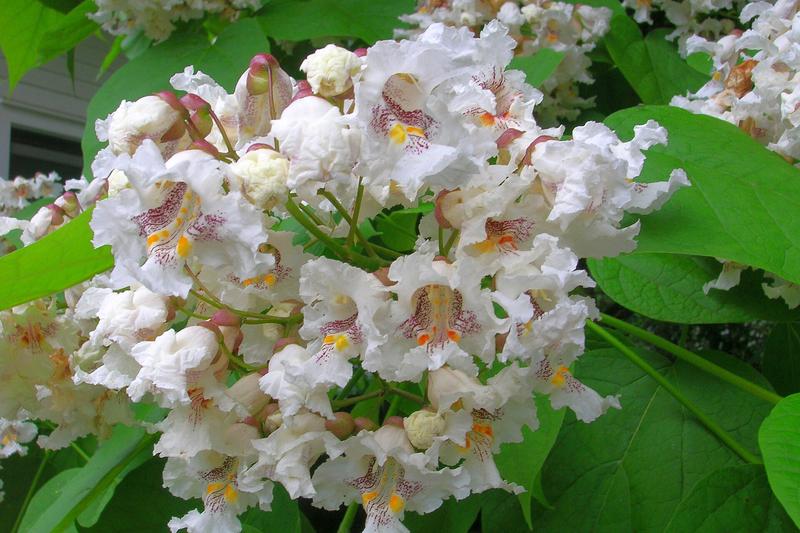
Quick facts
- Watering
- Weekly when young, minimal once established
- Sunlight
- Full sun to partial shade
- Soil
- Moist, well-drained, fertile
- Humans
- Unknown
- Cats
- Unknown
- Dogs
- Unknown
- Height
- 1000–1500 cm
- Spread
- 800–1200 cm
- Spacing
- 1000–1500 cm apart
- RHS recognition
- Award of Garden Merit
About Indian Bean Tree
The Indian Bean Tree is a striking deciduous tree native to the southeastern United States, prized in UK gardens for its large, heart-shaped leaves and showy white flower panicles in summer. It produces long, bean-like seed pods that persist through winter, giving the tree its common name and adding architectural interest. British gardeners value this tree for its exotic appearance, rapid growth, and ability to create a bold focal point in medium to large gardens.
UK fact: The Indian Bean Tree has been grown in British gardens since the 18th century and thrives particularly well in southern England, where warmer summers encourage the best flowering displays and pod production.
Watering Indian Bean Tree
Young Indian Bean Trees require regular watering during their first two growing seasons to establish a strong root system, particularly during dry spells. Water deeply once or twice weekly in dry weather, ensuring the soil remains moist but not waterlogged. Once established, these trees are remarkably drought-tolerant and typically require watering only during prolonged dry periods in summer. In typical UK conditions with regular rainfall, mature specimens rarely need supplementary watering.
Sunlight requirements
Indian Bean Trees perform best in full sun, which encourages the most prolific flowering and robust growth. They tolerate partial shade but may produce fewer flowers in shadier positions. In the UK, a south or west-facing position sheltered from strong winds is ideal, as the large leaves can be damaged by harsh winds.
Soil and feeding
Indian Bean Trees thrive in fertile, moisture-retentive soil that drains well, tolerating a wide range of soil types including clay, loam, and sandy soils. They prefer a neutral to slightly alkaline pH (6.5-7.5) but adapt to slightly acidic conditions. Improve heavy clay soils with organic matter before planting to enhance drainage, and enrich poor soils with well-rotted compost or manure to support vigorous growth.
Apply a balanced slow-release fertiliser in early spring around the base of young trees to encourage strong growth. Mature specimens rarely require feeding if planted in reasonably fertile soil, though a mulch of well-rotted compost or manure in spring helps retain moisture and provides gentle nutrition.
Pruning Indian Bean Tree
Prune Indian Bean Trees in late winter or early spring whilst dormant, removing any dead, damaged, or crossing branches to maintain a clear framework. Young trees benefit from formative pruning to establish a strong central leader and well-spaced branches. Mature trees require minimal pruning beyond removing unwanted growth or reducing size if necessary, though they tolerate hard pruning well if renovation is needed. Avoid pruning in autumn or winter when wounds may be slow to heal.
Propagating Indian Bean Tree
Indian Bean Trees are easily propagated from seed sown in spring, though seedlings may take several years to flower. Collect the long seed pods in autumn, extract the seeds, and sow them in pots of seed compost in a cold frame or unheated greenhouse. Semi-ripe cuttings taken in summer also root readily with bottom heat. Hardwood cuttings can be taken in winter and rooted outdoors in a sheltered spot, making this one of the easier ornamental trees to propagate at home.
Common problems
Indian Bean Trees are generally trouble-free in the UK, though the large leaves can suffer wind damage in exposed positions, appearing tattered by late summer. Verticillium wilt occasionally affects specimens, causing branch dieback and wilting foliage; remove affected branches promptly. Powdery mildew may appear on leaves in dry summers but rarely causes serious harm. Aphids sometimes colonise young growth in spring but are easily controlled with insecticidal soap or left for natural predators to manage.
Spot a problem with your plant? Photograph the affected area using the Loam app and it will suggest the most likely cause and treatment.
Safety
- Humans
-
Unknown
The seed pods and seeds may cause mild stomach upset if ingested in quantity; best kept away from young children.
- Cats
-
Unknown
No confirmed toxicity but ingestion of plant material may cause mild gastrointestinal upset; monitor cats with access to fallen leaves or pods.
- Dogs
-
Unknown
No confirmed toxicity but ingestion of plant material may cause mild gastrointestinal upset; monitor dogs with access to fallen leaves or pods.
Toxicity information is for general guidance only. If a person or pet has been exposed to this plant and you are concerned, seek advice from a medical professional or vet.
Seasonal care calendar
Monthly care guide for Indian Bean Tree in the UK, based on average conditions.
| Month | Care tasks |
|---|---|
| January | No action needed; tree is fully dormant. |
| February | Plan pruning work for late in the month if needed; check stakes and ties on young trees. |
| March | Complete any pruning before buds break; apply slow-release fertiliser to young trees and mulch around the base. |
| April | Watch for emerging leaves; water young trees if weather is dry. |
| May | Large heart-shaped leaves fully emerge; monitor for aphids on new growth and water during dry spells. |
| June | Enjoy the spectacular white flower panicles; continue watering young trees regularly. |
| July | Flowers fade and long seed pods begin to form; water during dry weather and take semi-ripe cuttings if propagating. |
| August | Seed pods continue developing; maintain watering for young trees during dry periods. |
| September | Reduce watering as growth slows; seed pods ripen and turn brown. |
| October | Collect seed pods for propagation if desired; leaves begin to yellow and fall. |
| November | Leaves drop fully, revealing the architectural seed pods; clear fallen leaves from around the base. |
| December | No action needed; enjoy the winter silhouette with persistent seed pods. |
Frequently asked questions
- How long does it take for an Indian Bean Tree to flower?
- Indian Bean Trees typically begin flowering 7-10 years after planting from seed, though grafted specimens may flower within 3-5 years. In the UK, trees flower best in warmer southern regions where summers are longer and hotter, producing their spectacular white panicles in June and July once mature.
- Why are the leaves on my Indian Bean Tree turning brown at the edges?
- Brown leaf edges are usually caused by wind damage or drought stress, both common in exposed UK gardens. The Loam app can help you track watering schedules and identify whether your tree needs better wind protection or more consistent moisture during dry spells.
- Can I grow an Indian Bean Tree in a small garden?
- Indian Bean Trees reach 10-15 metres tall with a broad canopy, making them unsuitable for small gardens unless regularly pruned. Consider the cultivar 'Nana' (also called 'Bungei'), which is grafted onto a standard stem and forms a compact rounded head rarely exceeding 3-4 metres, perfect for smaller spaces whilst retaining the attractive foliage.
Got a question about growing Indian Bean Tree that isn't covered here? Ask the Garden Advisor in the Loam app. It knows your saved plants and local conditions.
Related plants
This page was compiled with AI assistance and reviewed by our team. .