Mare's Tail
Equisetum arvense
Weeds and Invasives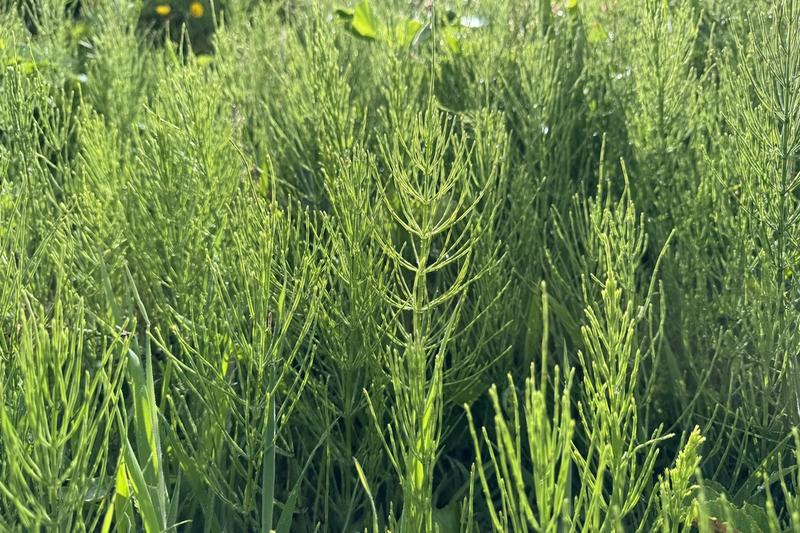
Quick facts
- Watering
- No watering required
- Sunlight
- Full sun to partial shade
- Soil
- Any soil, prefers heavy clay
- Humans
- Toxic
- Cats
- Toxic
- Dogs
- Toxic
- Height
- 20–60 cm
- Spread
- 100–300 cm
- Spacing
- 0 cm apart
About Mare's Tail
Mare's tail is a persistent perennial weed with distinctive hollow, jointed stems and whorls of needle-like branches resembling a horse's tail. This primitive plant, unchanged for millions of years, spreads aggressively through deep rhizomes that can extend 2 metres underground, making it one of the most challenging weeds in UK gardens. Rather than growing it intentionally, British gardeners focus on controlling and eradicating this invasive species from borders, lawns, and vegetable plots. Its presence often indicates compacted, poorly drained soil.
UK fact: Mare's tail has been present in Britain since prehistoric times and was traditionally used as a scouring rush to clean pewter and pots due to its high silica content, earning it the alternative name 'scouring rush' in rural communities.
Watering Mare's Tail
Mare's tail requires no supplementary watering and actually thrives in poorly drained, waterlogged conditions that many garden plants cannot tolerate. It is commonly found in damp areas, along drainage ditches, and in compacted clay soils where water collects. The plant's deep root system allows it to access moisture far below the surface, making it drought-tolerant once established. Improving drainage and soil structure can help suppress its growth over time.
Sunlight requirements
Mare's tail thrives in both full sun and partial shade, showing no particular preference and growing vigorously in all light conditions. It commonly colonises open borders, vegetable plots, and partially shaded areas beneath hedges or along north-facing walls. Its adaptability to varying light levels contributes to its success as an invasive weed throughout UK gardens.
Soil and feeding
Mare's tail grows in virtually any soil type but shows a strong preference for heavy, compacted clay with poor drainage and acidic to neutral pH (5.5-7.0). It thrives where soil structure is poor and oxygen levels are low, conditions that stress most cultivated plants. The weed is often an indicator of underlying drainage problems or soil compaction. Improving soil structure through the addition of organic matter and grit can help create conditions less favourable to mare's tail whilst benefiting desired plants.
Mare's tail requires no feeding and thrives in nutrient-poor soils. Applying fertiliser to infested areas may actually encourage more vigorous growth and should be avoided until the weed is fully eradicated.
Pruning Mare's Tail
Cutting or mowing mare's tail is generally ineffective as a control method and may stimulate the production of more shoots from the extensive underground rhizome network. If cutting back growth, remove all material immediately to prevent spores from the fertile stems (which appear in spring) from spreading. Repeated removal of top growth over several years can weaken the plant but will not eradicate it. For effective control, focus on systemic herbicide application or persistent physical removal of rhizomes.
Propagating Mare's Tail
Mare's tail propagates readily through its extensive rhizome system, with even tiny fragments capable of regenerating into new plants, making it extremely difficult to eradicate. It also spreads via spores produced on fertile stems that appear in early spring before the sterile, branched stems emerge. Any disturbance of infested soil, such as rotavating or digging, typically fragments the rhizomes and spreads the infestation further. Intentional propagation is strongly discouraged due to its invasive nature and the difficulty of subsequent removal.
Common problems
Mare's tail itself is not troubled by pests or diseases, which contributes to its success as an invasive weed. The primary problem for UK gardeners is controlling and eradicating this persistent plant, as its deep rhizomes (reaching 2 metres or more) make physical removal extremely challenging. Chemical control using glyphosate-based weedkillers requires repeated applications over several growing seasons and is most effective when applied to actively growing foliage in late summer. The plant's waxy coating on stems makes herbicide penetration difficult, so crushing stems before application or using a wetting agent improves efficacy.
Spot a problem with your plant? Photograph the affected area using the Loam app and it will suggest the most likely cause and treatment.
Safety
- Humans
-
Toxic
Mare's tail contains thiaminase, which breaks down thiamine (vitamin B1), and can cause toxicity if consumed in large quantities over time. Historically used medicinally, but internal use is not recommended without expert guidance.
- Cats
-
Toxic
Contains thiaminase and can cause thiamine deficiency if ingested regularly, though cats rarely consume this plant.
- Dogs
-
Toxic
Contains thiaminase which can lead to thiamine deficiency with repeated ingestion, though dogs typically avoid eating this plant due to its texture.
Toxicity information is for general guidance only. If a person or pet has been exposed to this plant and you are concerned, seek advice from a medical professional or vet.
Seasonal care calendar
Monthly care guide for Mare's Tail in the UK, based on average conditions.
| Month | Care tasks |
|---|---|
| January | Rhizomes dormant underground; plan control strategy for the coming season. |
| February | Rhizomes dormant; prepare for emergence of fertile stems in late month. |
| March | Fertile stems emerge bearing spore cones; remove immediately to prevent spread. |
| April | Sterile green stems begin emerging; start herbicide treatment programme if using chemical control. |
| May | Active growth of sterile stems; continue herbicide applications or physical removal. |
| June | Peak growth period; apply systemic weedkiller to actively growing foliage. |
| July | Continue control measures; optimal time for herbicide application as plants transport nutrients to rhizomes. |
| August | Late summer herbicide application most effective as nutrients move to underground rhizomes. |
| September | Final herbicide applications before dormancy; remove any remaining top growth. |
| October | Growth slowing; clear away dead stems to prevent overwintering sites for other pests. |
| November | Plants dying back; assess control success and plan next year's strategy. |
| December | Fully dormant; review control methods and consider professional advice if infestation persists. |
Frequently asked questions
- How do I get rid of mare's tail in my garden?
- Mare's tail is extremely difficult to eradicate due to its deep rhizomes. The most effective approach combines repeated applications of glyphosate-based weedkiller (crushing stems first to aid penetration) from late spring through late summer over 2-3 years, with persistent removal of all top growth. Physical removal requires excavating all rhizome fragments to at least 2 metres depth, which is rarely practical. Improving drainage and soil structure can help suppress regrowth over time.
- Why does mare's tail keep coming back after I've treated it?
- Mare's tail's extensive rhizome network can extend 2 metres deep and regenerate from tiny fragments, requiring persistent treatment over multiple seasons. The Loam app can help you track treatment dates, set reminders for optimal herbicide application timing in late summer, and monitor progress year-on-year to ensure your control strategy is working effectively.
- Is mare's tail the same as horsetail?
- Yes, mare's tail (Equisetum arvense) is commonly called field horsetail, and the terms are often used interchangeably in the UK. However, it should not be confused with the aquatic plant Hippuris vulgaris, which is also sometimes called mare's tail. The Equisetum species is the problematic garden weed with jointed, hollow stems and whorls of needle-like branches.
Got a question about growing Mare's Tail that isn't covered here? Ask the Garden Advisor in the Loam app. It knows your saved plants and local conditions.
Related plants
This page was compiled with AI assistance and reviewed by our team. .